The most dangerous misconception in DeFi is that a wallet is secure because it supports many chains. In practice, security does not come from the number of networks a wallet can connect to. It comes from how clearly the user can understand a transaction, how carefully permissions are managed, and how well the signing device is isolated from hostile software. A multi-chain wallet can reduce confusion in some situations while creating new opportunities for error in others.
That distinction matters for US DeFi users who move between Ethereum, layer-2 networks, and other compatible ecosystems. The same address may appear across several networks, but the assets, contracts, bridges, fees, and risks are not identical. Rabby Wallet is best understood not as a guarantee against loss, but as an interface intended to make transaction context and contract interaction easier to inspect before a signature is approved.
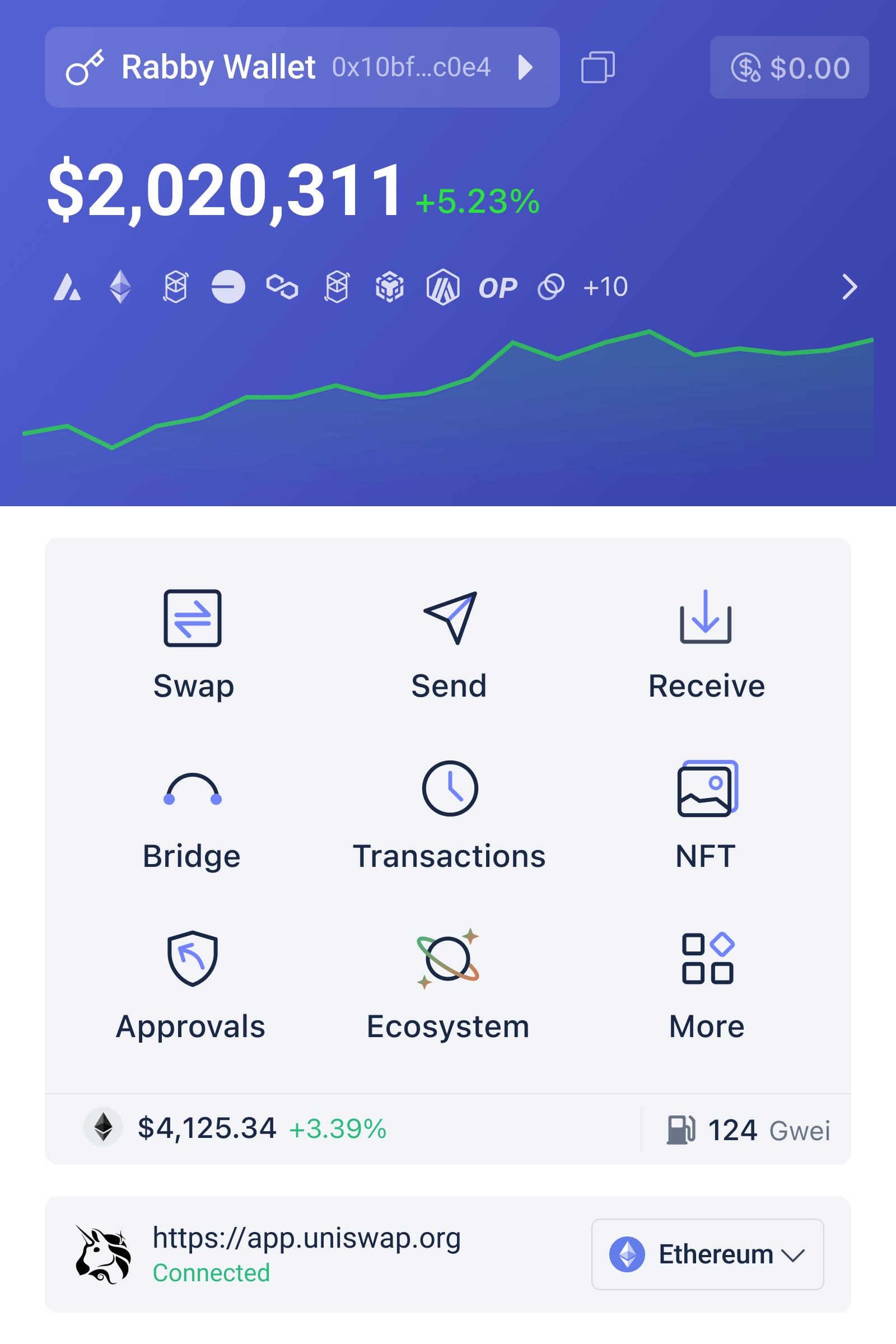
The First Myth: One Address Means One Risk Profile
Many users treat a wallet address as a single account with a single security status. That mental model is incomplete. An address can be represented on several networks, but each network has its own balances, native gas asset, applications, token contracts, and transaction history. A token that looks familiar may have a different contract address on another chain. A decentralized application that is reputable on one network may be absent, cloned, or poorly maintained on another.
This is why multi-chain security is partly a problem of information architecture. The wallet must help the user answer several questions before signing: Which chain is active? Which contract will receive the transaction? What assets are being spent? Is the action a one-time transfer or a continuing token approval? Is the requested permission broader than necessary? A clear interface cannot answer every question automatically, but it can make dangerous ambiguity more visible.
The distinction between a transaction and an approval is especially important. A transaction may transfer tokens immediately. An approval can authorize a contract to spend tokens later, sometimes up to a very large limit. Users frequently remember the first interaction but forget the continuing permission. In that sense, wallet security is not only about protecting a private key; it is also about controlling the authority delegated to contracts.
How Rabby Wallet Fits Into the Security Model
A browser wallet generally operates as a signing interface between the user, a decentralized application, and a blockchain network. The application proposes an action. The wallet displays available transaction information. The user then either rejects or signs it. Once broadcast, the network validates the signature and executes the transaction according to the relevant contract code. The wallet does not rewrite that code or reverse a completed transfer.
Rabby Wallet’s practical value for multi-chain users lies in the inspection layer before signing. Features such as transaction previews, network awareness, and warnings about certain contract interactions can help users notice mismatches that a minimal wallet display might leave obscure. This is a meaningful improvement in decision quality, especially when a user is moving quickly between protocols. It is not the same as autonomous protection.
Readers who are evaluating the browser-extension setup can review a rabby extension download guide, but installation should still be treated as a security event. Verify the source, inspect the browser extension’s publisher information, avoid sponsored search results that imitate official pages, and never enter a recovery phrase into a website or installation form. The recovery phrase belongs in the wallet’s secure setup process, not in a web page.
The non-obvious point is that better warnings can change user behavior in both directions. A useful warning slows down a risky action. Too many vague warnings, however, may produce alert fatigue: users click through because every interaction appears alarming. The quality of a wallet’s security experience therefore depends not only on detection, but also on the relevance and comprehensibility of the explanation.
Three Alternatives and the Trade-Offs They Make
Browser extension wallets
A browser extension is convenient because it connects directly to DeFi applications. It supports rapid interaction with decentralized exchanges, lending markets, liquid staking services, and governance tools. The trade-off is that the browser is a large attack surface. Malicious extensions, compromised websites, deceptive pop-ups, clipboard manipulation, and phishing domains can all influence what the user sees or signs.
A multi-chain extension may also make network switching feel effortless. That convenience is helpful, but it can hide the operational difference between networks. A user who understands the destination application but overlooks the active chain can approve the wrong contract or misjudge fees. Convenience reduces friction; it does not necessarily reduce risk.
Hardware wallets
A hardware wallet keeps the signing key in a separate device and normally requires physical confirmation. This can substantially reduce the consequences of malware that gains access to a computer, because possession of the computer alone is not enough to produce a valid signature. For larger balances or long-term holdings, this separation is a strong security boundary.
Hardware signing is not a complete defense. If a user approves a malicious transaction on the device, the hardware wallet may faithfully sign it. Device isolation protects the key more directly than it protects the user’s judgment. Hardware wallets can also add friction when many small DeFi interactions are required, and complicated transaction details may still be difficult to interpret on a small screen. A common robust arrangement is to use a hardware wallet for treasury or savings assets and a smaller, separate account for experimental activity.
Custodial platforms
A regulated or established custodial platform can simplify key management for users who do not want to handle recovery phrases. It may offer familiar account recovery processes and additional monitoring. The cost is a different risk model: the user does not control the private key, and access depends on the platform’s operational decisions, account controls, solvency, and compliance processes. Custody changes the location of trust; it does not eliminate trust.
For active DeFi participation, custody also limits direct control over application permissions and on-chain execution. A self-custody wallet offers greater autonomy, but requires better operational discipline. There is no universally safest option independent of the user’s goals, balance, technical ability, and tolerance for responsibility.
The Security Boundary That Wallets Cannot Remove
Wallet interfaces can inspect transaction data, but smart contracts remain programs with their own logic. A simulation may indicate what a transaction appears likely to do under current conditions, yet a simulation is not a mathematical guarantee of future behavior. State can change between simulation and execution. A contract may depend on external calls, unusual token behavior, oracle data, block timing, or conditions that are difficult to model perfectly.
There is also a fundamental difference between identifying a contract and judging its economic safety. A wallet may display an address, a token amount, or a warning. It cannot establish that a protocol will remain solvent, that a yield is sustainable, or that a bridge will operate safely under stress. Those are protocol, governance, liquidity, and infrastructure questions. Security signals are evidence for a decision, not substitutes for due diligence.
Users should be especially cautious with unlimited approvals, signature requests that appear unrelated to the current task, urgent claims requiring a wallet connection, and websites whose domain names differ subtly from the intended application. A strong routine is to pause whenever the requested action is not easily explainable in ordinary language. “I am allowing this contract to spend a specified token” is materially different from “I am signing something because the site says it is required.”
A Reusable Decision Framework for DeFi Users
Before signing, apply a four-part check: identity, intent, authority, and reversibility. Identity asks whether the domain, chain, contract, and token are the ones you expected. Intent asks what the action will do now. Authority asks what future control you are granting, particularly through approvals or signatures. Reversibility asks whether the action can be cancelled, revoked, or recovered if your interpretation is wrong.
This framework is more useful than simply asking whether a wallet is “safe.” It separates risks that are often confused. A stolen seed phrase is a key-compromise problem. A malicious approval is an authority problem. A fake website is an identity problem. An irreversible transfer to the wrong address is a human-factors problem. Rabby Wallet may help with visibility across these categories, but the controls available for each category are different.
After using a new protocol, review active approvals rather than assuming that disconnecting the website removed permission. Disconnecting affects the relationship between the browser and the application; it does not necessarily revoke an on-chain allowance. Revoke only permissions you understand, and remember that revocation itself is a transaction requiring gas and careful network selection.
What to Watch as Multi-Chain Use Expands
If multi-chain activity continues to grow, the most valuable wallet improvements will likely be contextual rather than merely cosmetic. Users need reliable distinctions between networks, clearer explanations of permissions, better handling of bridged assets, and warnings that prioritize material risk instead of producing indiscriminate pop-ups. The relevant signal is not how many chains a wallet lists, but whether the interface reduces mistaken assumptions as complexity increases.
That future is conditional. Better interfaces can reduce avoidable errors if users read them and if the underlying detection systems remain accurate. They cannot solve compromised recovery phrases, dishonest operators, flawed contract code, or deliberate approval of a suspicious transaction. The boundary is important because overconfidence is itself a security vulnerability.
Frequently Asked Questions
Is a multi-chain wallet safer than using separate wallets for each network?
Not automatically. One interface can reduce switching mistakes and make portfolio management easier, but it can also concentrate activity and encourage users to assume that similar-looking assets and applications have identical risks. Separate wallets may improve compartmentalization, while a multi-chain wallet may improve visibility. The better choice depends on whether convenience or isolation is the dominant requirement.
Can Rabby Wallet prevent a malicious DeFi transaction?
No wallet can guarantee prevention. A wallet may provide warnings, previews, or simulations that help users identify suspicious behavior before signing. Those tools can fail when contract logic is complex, blockchain state changes, information is incomplete, or the user approves the action despite the warning. The final signature remains a consequential authorization.
Should a hardware wallet still be used with a browser-based DeFi wallet?
For users holding substantial value, hardware-backed signing can add an important layer of key isolation. It does not remove the need to inspect contract interactions, because a hardware device can still sign a transaction that the user misunderstands. A practical approach is to separate long-term holdings from a smaller account used for higher-risk or experimental DeFi activity.
What is the simplest security habit for multi-chain users?
Read the action as a permission, not merely as a button click. Confirm the network, recipient or contract, assets involved, spending allowance, and whether the action can be undone. If any part cannot be explained clearly, reject the request and investigate before trying again.
The central lesson is straightforward but easy to neglect: a wallet is a control panel, not a force field. Rabby Wallet can make multi-chain activity more legible and may help surface risks before a signature, but durable security comes from combining clear transaction review, limited permissions, key isolation where appropriate, and disciplined skepticism. In DeFi, the safest decision is often not the fastest approval; it is the one whose consequences you can accurately describe before signing.

![Bewerbungsgespräch zum Grundstück im Rettungsgarten [erstattungsfähig]](https://shop.topp-vernetzt.de/wp-content/uploads/2022/05/photo_2024-11-07_08-53-46-300x300.jpg)